
Kilibreaux
-
Posts
216 -
Joined
-
Last visited
Never -
Days Won
2
Everything posted by Kilibreaux
-
To me what's most important is that the GSG is proving to be a VERY durable weapon! While .22LR ammo has gone up in price, those who laid in a stockpile several years ago are still benefitting from the reality that if the SHTF they have the "option" of laying down a high-volume base of fire without "wasting" precious CF ammo. On top of that, with the appropriate modifications, the GSG is a VERY nice platform...reliable magazines abound, the receiver is built like a truck, and the bolt rides inside a SUB-receiver that only serves to insure the entire gun will last forever! Smart owners have by now figured out solutions for suppression since that is one of the prime requirements for an urban defense weapon. BTW, in case everyone has missed it, I've been noticing a lot of YouTube videos that talk about "hammer mods' and "Trigger mods" etc....but it all started here!
-
The lower tang?
-
has anyone painted their GSG ??
Kilibreaux replied to rentprop1's topic in GSG-522, GSG-5 Mods and Upgrades
very interesting camp pattern! -
FABULOUS! I know a LOT of people own GSG's so I wonder why so few are still frequenting this forum?
-
I know...thank you!
-
Well thank you! I think. Hey the rifle only cost $600... Seriously though, ATI provides a complete list of replacement parts, so it's easy to replace a part if needed and bring the gun back to OEM condition, though I would NEVER reverse the hammer/strut mod on a gun I intended to use. I think I've bought about four barrels for my GSG just for experimenting purposes...I would proffer that the GSG and STG are equal to the "Gold standard" 10/22 for modular construction, and variety of configurations, only at present the ATI series require custom mods to sub components while the Ruger benefits from decades of aftermarket interest.
-
I'll tell you I was a little hesitant to pay the higher price just for a "look-a-like" rifle but now that I'm looking at the STG first person I'm glad I bought it and I'm considering grabbing a couple more against the day when they end production. The STG is so overbuilt it will last for many lifetimes. They definitely improved the fire control group and made the gun capable of total disassembly with an Allen wrench and Torx driver. Whereas the GSG is somewhat daunting and "fiddly" to completely tear down and put back together, the STG is actually fun. Another point is the bolt assembly does NOT just spring out when the stock is removed as has been erroneously reported. The trigger housing has a slight angle that matches the "buffer" and prevents the trigger housing from swinging freely. The entire bolt group comes out with no tools needed and the steel bolt rides in a thick, steel U-channel that itself slides into receiver guides. This steel, bolt "carrier" for lack of the proper name at the moment, indexes alongside the massive barrel trunion thus barrel, bolt, and carrier are held in alignment. There are no tiny little screws to worry about failing. Because the cocking rod is located in the receiver the upper tube above the barrel provides structural support and cosmetic appeal for the GSG-like slender barrel. IF one wished to do so any number of custom "front ends" could be created and quickly attached and detached with no modification at all to the main rifle. One could swap out a super-short barreled, suppressed front end then swap back to original configuration in about 2 minutes. The barrel/trunion unit is EASY to remove and American International supplies replacement parts. The more I examine the STG that more impressed I am. It's full size, heavy, with surprising balance. As I think about it, the ergonomics of the STG are as close as any rifle has come the near perfect ergos of the AR-15. And before I forget, the stock mount has a sort of built in adjustment to remove lateral play - which ain't much to begin with. A large receiver screw head lies under the stock's metal housing when the stock is in place. By ever so slightly backing out this screw all play is removed.
-
A point to add is that the hammer now rests fully against the bolt which is slightly better than I managed with the GSG strut mod...but I've figured out why! With the strut re-contoured to allow it to swing deeper into the hammer, the lower tang becomes the limiter, however this cannot be determined without comparing how the parts interact while in place. So it becomes necessary to shorten the lower tang to allow the strut to move even farther than manually comparing the parts would indicate. The result is the hammer fully down with zero play. This equals a safer action, less chance of case rupture, and less fouling blown back into the receiver.
-
At first blush I thought the STG would be far to specialized as a replica to equal the well-known, chamelionesque nature of the GSG-5/522, but today I discovered an interesting aspect of the STG; the entire front outer barrel assembly is easily removed leaving nothing forward of the flat face of the receiver except barrel. And the gun is fully functional in this configuration! This means one could SBR an STG down to a "PK" length fitted with a large diameter integral suppressor that would result in a rather interesting and highly functional hybrid.
-
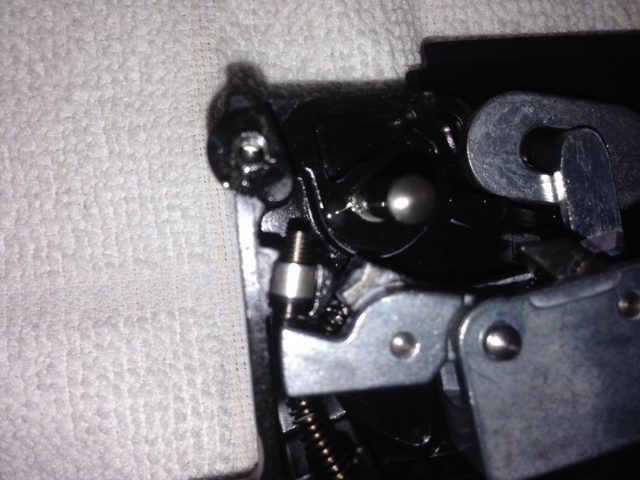
Closeup of small set screw that permits sear to hammer engagement adjustment. The rifle is supplied with a tiny Allen wrench and the adjustment can be made with the trigger housing swung open.

-
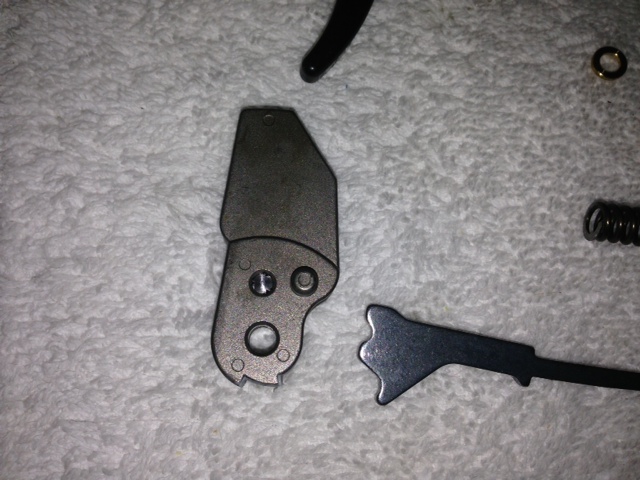
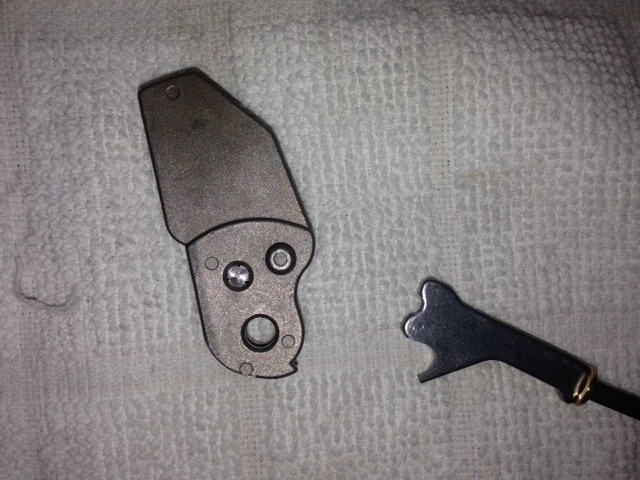
Hammer and strut before and after modification.
-
UPDATE: After full disassembly an update is in order. The wood grip panels appear to be a very dense, pressed wood similar to MDF only with a much finer grain structure. I don't see any reason they won't do the intended job. Unlike the GSG no tools are required for field stripping, but if one wishes to separate the trigger housing its a simple job with a T10 Torx driver. The sub components are very heavy and thick-walled. The grip frame separates into halves and the internals appear very well fitted. The FCG is the same pattern as the GSG albeit a bit crisper in execution. Full disassembly is much easier than the GSG BTW. I did find a negative...the barrel nose is slid inside the front sight housing and has noticeable axial movement which may or may not adversely affect accuracy. The front sight unit is pinned to the cocking tube and also has a small amount of wiggle with probably limits accuracy, but these issues are easily correctable by applying some high temp RTV sealant around the muzzle and letting it cure while inserted in the front sight housing. This would stabilize both barrel and sight. The cocking rod is in fact polymer but seems fully up to its assigned task. The main body of the receiver separates into halves and the "shells" are massively thick. I would not bet on any of the receiver parts to ever break under normal, gun intended usage...to "break" this gun's main structure would require deliberate attack with a hammer! BTW when the stock is mounted it feels secure and without wobble. The gun will indeed function and fire without the stock attached as long as the attachment pin is inserted. I have already modified the hammer and hammer strut to eliminate the rebound feature and will post photos of that soon. Anyone thinking about suppression should be aware that unlike the GSG the apparent barrel muzzle is a casting and would require machinist modification to make threads, but even then it doesn't appear any standard OTC suppressor would fit...so that will be an all custom solution.
-
I've been waiting on small rifle primers to come in stock - at reasonable prices for the last several months. I've got a .300 AAC build sitting around dormant awaiting either the supplies to reload for it, or loaded ammo.
-
With the STG-44 having been out for about a year now, I would have expected quite a little flurry of posting about it yet there is just one post since last year! Well, as it happens I took the plunge and picked up mine today - complete with unfinished wood crate which I "hear" will only be supplied with the initial issue of rifles, and the crate IS a nifty touch - certainly niftier than a cardboard box and the rifle is literally anchored in place. Okay, so let me tell you something about this thing...the stuff you have NOT read or heard by the usual online sites - okay a lot you probably have heard but some detail stuff I certainly haven't seen. Anyone who has followed my posts on the GSG-5/522 knows I have a penchant for getting into the inner workings and "correcting" all the stuff the litigation specialists got wrong! First, the gun is an amazing "copy" of the original...not a speck of plastic to be found anywhere! Genuine wood stock and grip panels and the rest is metal. It didn't pass the magnet test so the entire receiver may well be made from some type of Zinc alloy (OH MY!), but if it is it's hella overbuilt! It also looks to be stamped rather than cast as is the GSG-5...I say this based on what appear to be folded over seams, but I must say, whatever "metal" it is, and however it is manufactured the receiver and trigger housing are thick. I have absolutely no doubt that if the need arose this rifle could be used to beat someone to death and still be capable of shooting thousands of rounds! The rifle is full-size and feels very good in the hands. It comes up and mounts cleanly and the sights are crisp and easy to see. The sheet metal forend is a nice touch...slim and zero play. The butt stock is fitted into a metal mount that slides on snug and is retained by a push-pin. When the stock is removed and the trigger housing allowed to swing downward the spring-loaded bolt/cocking tube parts spring out. The solid steel, high-quality bolt rides inside a STEEL insert that fits inside the already massive receiver. This means the bolt's movement is all steel on steel...no alloy housing, no screws, it is a very clean and crisp looking affair very much like those used for AR-15 sub-caliber conversions. What sets the STG apart from the GSG-5 is the trigger group...on first blush it feels better, a stiff release with little travel. One thing that is obvious is they incorporated a rebounding hammer very much like the one used on the GSG-5 and sure enough with the hammer down the bolt can be retracted a good 1/4" before any resistance is felt from the hammer and hammer spring. Of course this absolutely WILL NOT DO so before I even take it out to shoot I'll be modifying the hammer strut to place greater closing force on the bolt. They wisely left out the magazine disconnect safety and believe it or not a firing pin safety! (Maybe they were reading this site!). Other than the hammer strut I can't see anything that needs "changing", but we'll see once I crack open the trigger housing. It does have an honest - real last shot bolt hold-open that certainly works as expected. The barrel is classic GSG - .473" diameter threaded into a massive, zinc trunion and running into and inside the "faux" outer barrel for original replical appearance. This rifle would look really sweet with an SBR'd 10-12" barrel which looks to be fairly easy to do, however most owners will want to keep the stock configuration. Unlike the GSG-5 which can be readily adapted to the 9" or even 4.75" PK barrel the STG is meant to be enjoyed the way it is supplied. It also has a genuine, metal, "real" spring-loaded ejection port cover that flips UP when the bolt opens...a very nice homage to the original, and serves to make the replica that much better. The magazine appears to be equally overbuilt like the GSG-5 mags...it's larger of course but is of the same two-piece clam-shell construction. The wood buttstock has an original-esque cleaning kit recess in the top with a spring-loaded gate - VERY nice touch, and the rifle will accept an original STG-44 sling. Okay, so I haven't shot it yet, but if initial impressions mean anything, I fully expect the STG-44 to be accurate and reliable. Anyone willing to pay the going rate for "tactical" .22's needs to realize the STG-44 is a top-tier "replica" that is fully capable and worth the added vig. Hopefully I will soon get the time to do a full disassembly and take some photos of the internals...and do the hammer strut mod!
-
You can always saunter into Home Depot and pick of up a tube of high-temp RTV sealant. Pull the cocking rod and slather a generous amount onto the front end of the cocking rod and carefully shape it to match the diameter and let it harden. You can build up "layers" to create a formidable depth of cushion, and trim it with a sharp x-acto blade. To prove how durable the stuff is, ten years ago I applied some to the slot inside the operating rod of my Ruger Mini-14 to act as a spacer/buffer causing the resting force of the operating rod to be exerted on the bolt lug instead of the gas piston under the barrel (which is why OEM Mini-14's have erratic accuracy). The gun immediately started delivering 2-3" consistent groups at 100 meters and the RTV is still there to this day...after who knows how many rounds, but even if and when it does "wear out" it's easy and inexpensive to replace.
-
has anyone painted their GSG ??
Kilibreaux replied to rentprop1's topic in GSG-522, GSG-5 Mods and Upgrades
Other than using red and white crayon to highlight the stampings mine is still bone stock black/charcoal. I HAVE however been giving some thought to freshening it up by painting it OD or desert sand. I have no doubt the gun will look fabulous in either color. Because of the rough textured anodized finish I'm confident any quality gun paint such as Gun Kote will adhere well. -
While fondling my GSG-5/522 the other night I thought it was time to ask how others feel about their GSG's now that the gun has been in circulation long enough to get feedback on areas like reliability, durability, parts breakage, parts availability, etc. I still marvel at the sheer "beef" of the GSG's receiver and the "sub-receiver" inside that houses the bolt...the gun is truly built like a tank and after several years of being banged around and treated indifferently I feel emboldened to opine that the GSG is proving to be EXTREMELY durable. Mine of course has "all" the mods such as the hammer strut mod, trigger travel mod, firing pin safety removed, firing pin safety lever cut down, secondary helper coil spring under the sear arm, and magazine safety removed. I marvel at just how short and crisp the trigger pull feels to that original, long, mushy, indistinct pull out of the box. With thousands of rounds fired - high velocity, hyper velocity, subsonic, with and without a suppressor attached the beefy little carbine has proven to be highly reliable...I'd say I'm more impressed with it now than I was two years ago! What do others think?
-
www.hotgunparts.com lists the entire conversion package as "in stock" for $50. This is the package I bought a few years back and it comes with both the -5 metal front sight/cocking tube, and a plastic -5PK FS/cocking tube. Comes with the smooth, Navy style pistol grip and classive safety lever, and the half-moon cocking knob. Add an MP-5 rear sight - still available from www.rrages.com and you have an identical setup to the MP-5. The conversion package also includes a metal upper receiver insert to replace the plastic version supplied with the GSG-522 with the plastic rail and tiny screws that render the entire setup meaningless. Once you install the metal top piece you can mount a "real" HK style claw mount that is genuinely sturdy enough to handle the weight of an optical sight.
-
It is intentionally smaller than a standard 1911 to conform more to the reality of the .22LR cartridge. It reminds me of the old Star Model S .380 which was a scaled down 1911 with identical function. Or the more recent Colt .380 Government which is also a reduced scale 1911 profile. The pistols are out now...rather overpriced I think, but generally have received positive reviews.
-
Took the M&P22 out to test and ran 1000 rounds of Blazer through it with zero failures! I also ran 100 rounds of Aguila Supermax hollopoint and 100 rounds of the solid nose version with zero failures! I mean, the gun went bang EVERY time, ejected and fed the next round EVERY time! I expect to have a certain number of duds when shooting bulk grade .22LR, so I'm genuinely impressed with how well this pistol functioned!
-
In this era where everybody and his sister is jumping into the "tactical .22" market it's worth nothing the GSG series is the "ideal" option. The magazine is of the correct size to handle the .22LR cartridge, and the platform is capable of accepting any and modifications that bring it into line with any "factory MP5." The GSG mags are very well made, sturdy, and have proven to be highly reliable. The GSG has a honest-to-goodness bolt hold-open lock. The GSG is based on a design originally housing a 9" barrel which makes it modifiable using factory available parts. The GSG is the same "pattern" as the MP5 and will accept the same furniture. Thanks to the continued introduction of new .22 Tactical firearms, the price of the GSG has diminished...which means, "go buy the GSG!"
-
I think what surprises people about Kahr pistols is how compact and light they are. The Glock 36 would appear to be a direct response to Kahr, yet even then it's not as compact nor light.Kahr makes outstanding pistols, and while they aren't "cheap" they are something one can bet their life on. I have a Kahr P380 that fits in a front jeans pocket with ease. It weighs less than 10 oz empty and has THE SMOOTHEST, LIGHTEST, double-action pull I've ever experienced. Kahr's little .380 is so small and light they even offer a neck carry option! While I love and appreciate what Glock brings to the table in terms of service grade size and style, I also appreciate that any model Kahr is going to be as compact as any pistol can be made, combined with the smoothest trigger pull imaginable.
-
What is the caliber?
-
I've been reading some pages and posts on handgun reliability and thought I'd post something about it. There is a "common" yet erroneous belief that modern DA revolvers are "reliable certain" compared to say, semiauto pistols. People mistakenly believe they have "six sure shots" with a revolver but only one "sure shot" with the semiauto - if that. Of course NEITHER of those two styles is more reliable than the Single action, and believe it or not the Single action is superior to the Single SHOT except for the Single shot design ability to handle monster cartridges that place it outside the normal discussion. A modern Semiauto - chambered and appropriately "cocked" is HIGHLY reliable and will over a number of shots, prove to be MORE reliable than the modern double-action revolver! The Glock line is probably the most recognized and easily exampled semiauto...it has very few internal parts (33), ample dimensional allowance, and has been demonstrated by actual tests to handle copious amounts of external fouling yet still go back into service with a few "shakes." Even the 1911 cannot boast to equal this level of reliability...and remember, the 1911 BEAT OUT the double-action revolvers of its day to be adopted by the Army. All Double-action revolvers share the same engineered IN malfunction points. A trigger short-stroke can result in the cylinder rotating while the hammer does not cock...this is INHERENT in a "trigger cocking" mechanism such as is found on ALL double-action revolvers. There is NOTHING the user can do to fix this...under stress fire people tend to lose fine motor skill to the enhancement of gross motor strength. Another mechanical issue with revolver is that a slightly lesser short-stroke can cause the gun to BIND and become completely locked up or damaged to the point of needing repair! IF...and this condition is SO easy to demonstrate, the operator short-strokes at just the right point, the trigger and hammer will BIND and the hammer will not cock, nor will the cylinder rotate....please note these are OPERATOR induced malfunctions that are impossible to eliminate and impossible to "train around." IF one gets the first six shots out, opening the DA revolver's cylinder opens the door to massive mechanical failure. A tiny grain of unburned powder or powder debris can become trapped between crane and frame causing the gun to fail to lockup...useless. Even with scrupulous training, the revolver has innate mechanical "booby-traps." IF the operator ejects the spent cartridges with the muzzle down, powder residue can find itself into operating points, and the ejector star itself becomes a point of malfunction because the empty cases can push up, then drop back down UNDER the ejector star! NONE of the above related issues can impact the semiautomatic pistol. However, the semiauto does require that its engineered geometry and manufacturing tolerances result in efficient chambering. The semiauto also demands the fired case be efficiently ejected - or the gun binds up. ON THE OTHER HAND...the "old timey" Single-action revolver has SIX - as close to guaranteed shots as humanly possible!!! The cylinder rotates off the HAMMER which is thumb-cocked....meaning it will rotate. The trigger is "secondary" because IF it breaks it harms nothing other than the operator fires by hammer-cocking. As with the DA revolver, a failed primer means the operator recocks and brings up a fresh round, with the exception being, the DA revolver can JAM during this process....the single action cannot. The single action has no internal potential to jam....since the cylinder does not swing out, it cannot be "bound up" by firing debris getting between parts....it's SIX, damn near (as close to humanly possible) guaranteed shots! The single-shot on the other hand, loses to the single action because the SA can pump out 5 or 6 shots without HUMAN intervention. The single shot must be reloaded shot for shot....reliable, but LESS reliable under stress-fire than a pre-loaded cylinder mounted in a mechanical system that minimizes mechanical potential for error....the SINGLE ACTION.
-
Yes he IS ending up with a cartridge revolver sans the 4473 link! That's the great "secret" (shssss) about buying Blackpowder revolvers and retrofitting them to accept cartridges! However, this is completely legal, just as it is legal to construct one's own firearms for personal use. You will note a concommitant rise in Blackpowder firearms sales (and cost) as aftermarket conversion kits have become available.There is something worth remembering..."back in the day" when cap & ball revolvers were standard issue by the Militaries, they were not loaded or reloaded using loose powder and ball. They made use of paper cartridges designed to be quickly rammed home - bursting the paper for fast loading, and this is the reason "military" charges were generally lower than maximum loose charges. No sane person carrying a .36 Navy, or even .44 Army would deliberately down load it for defensive purposes unless they were using the "cartridges" of the age....similar to today. A point worth making is that the "ideal" modern rendention of a cap & ball era revolver is the 1858 Remington .44, and if possible the 5.5" barrel model. Forget converting it to take cartridges, for FAR LESS money you can buy two or three spare cylinders, each of which can be PRE-loaded and carried much like speedloaders. The loading rammer acts to anchor the base pin, so to quickly reload one need only place the revolver on half-cock, release the loading rammer, then slide the base pin forward to drop out the cylinder. The bullet seating stem on the loading rammer can be removed so the lever can be simply released and dropped without the stem entering the cylinder and binding up the gun. So, from a RELOADING standpoint, an original configuration is superior to modern cartridges, close to par with a swing-out cylinder using speedloaders, and FASTER than a swing-out cylinder being individually loaded! On the other hand, an original .44 C&B converted to .45 Colt - or even .45 ACP results in a far more powerful weapon.